
AI Website vs Custom Website: Pros, Cons, SEO & What Businesses Should Know
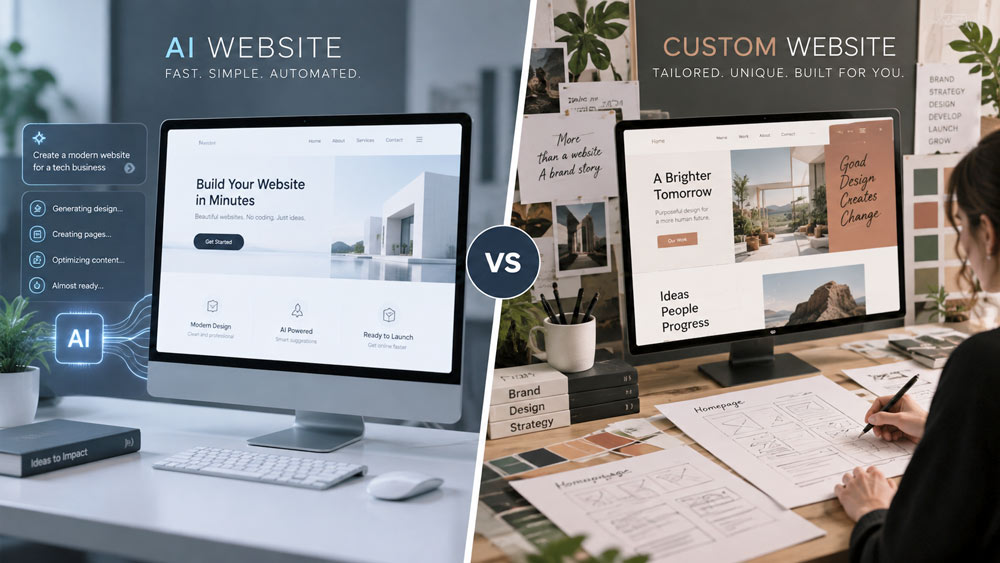
Artificial intelligence can now generate an impressive-looking website in minutes. Provide an AI website builder with your business name, industry, services, preferred colours and a few instructions, and it may produce a homepage, service pages, images and even basic website copy almost instantly.
That is a major step forward for web design.
But does a website that can be created quickly automatically become a website that can attract customers, rank in search engines, communicate your brand and support your business for years?
Not necessarily.
The real discussion around AI websites vs custom websites should not be about whether AI is good or bad. AI is an extremely useful tool. The bigger question is whether the website has the strategy, research, branding, SEO foundation, content, user experience and technical structure required to accomplish the business objective behind it.
Quick Answer: Is an AI Website Better Than a Custom Website?
An AI-generated website can be an excellent option when speed, simplicity and lower initial cost are the main priorities. It can produce attractive layouts quickly and significantly reduce the work required to launch a basic website.
A professionally planned custom website generally provides greater control over branding, user journeys, SEO architecture, functionality, content management and future scalability.
However, the technology used to create the website does not automatically determine its SEO performance.
Google has clarified that appropriate use of AI or automation is not against its Search guidelines. Its systems focus on the quality, originality, and usefulness of content rather than simply how that content was produced. According to Google’s guidance on AI-generated content, appropriate use of AI is not against its Search guidelines; Google focuses more on quality, originality and usefulness.
The strongest approach for many businesses may therefore be a combination: use AI for efficiency while keeping humans responsible for strategy, research, design decisions, quality control and optimization.
AI Website vs Custom Website: At a Glance
| Factor | AI-Generated Website | Custom Human-Designed Website |
|---|---|---|
| Initial development speed | Very fast | Usually slower |
| Initial cost | Often lower | Usually higher |
| Brand customization | Can be good with detailed prompting | Can be built specifically around the brand |
| Unique visual identity | Depends heavily on prompts and platform | Greater creative control |
| Keyword strategy | Usually requires additional research | Can be planned before development |
| On-page SEO | Basic automation may be available | Can be optimized page by page |
| Technical SEO | Platform-dependent | Greater implementation control |
| Content management | Depends on the AI platform | CMS can be selected around business needs |
| Scalability | Depends on platform limitations | Can be planned for future expansion |
| Custom integrations | May be limited | Greater flexibility |
| Real business photography | Must normally be provided | Can be built into the creative strategy |
| Long-term ownership | Platform-dependent | Greater control when built on an open or flexible CMS |
| Conversion strategy | Often based on standard patterns | Can be tailored to customer behaviour |
The biggest difference is therefore not simply AI versus a web designer. It is the amount of business strategy being applied before and during development.
The Advantages of AI-Generated Websites
AI website builders deserve credit for what they do well.
1. Websites Can Be Created Extremely Quickly
A traditional website can involve discovery meetings, sitemap planning, wireframes, design, development, content writing, revisions and testing.
AI can compress parts of that process dramatically.
For a startup that simply needs a professional online presence, an event page, a temporary campaign website or a small informational site, this speed can be valuable.
2. AI Can Reduce Initial Website Costs
Automation reduces some of the manual work associated with design and content creation.
A small business with a limited starting budget may therefore be able to create something far more professional than it could have produced independently only a few years ago.
3. Modern AI Designs Can Look Very Good
AI-generated websites are no longer limited to primitive templates.
With good prompts, appropriate brand colours, strong typography and quality images, AI website builders can generate polished, responsive layouts.
That makes AI particularly useful during brainstorming and early design stages.
4. AI Makes Experimentation Easier
Want to see a different hero section?
A different headline?
Another page layout?
AI can generate alternatives quickly, allowing designers and business owners to explore more ideas without rebuilding everything manually.
This is one reason AI will almost certainly remain part of modern professional web design.
Where AI Website Builders Can Struggle
The challenges usually begin when a website needs to become more than an attractive digital brochure.
A business website may need to communicate credibility, outperform competitors in search, support multiple locations, integrate specialized software, generate leads and continue evolving for five or ten years.
Those requirements demand more than an attractive layout.
1. AI Websites Can Start Looking Familiar
AI is trained around existing patterns.
Website builders also work within design systems containing familiar components such as hero banners, feature cards, testimonials, service grids, and calls to action.
As a result, websites generated from generic prompts can sometimes have a familiar appearance.
This does not mean every AI website looks identical. Detailed prompting, custom graphics, professional photography, custom development, and strong creative direction can produce very different results.
But there is an important lesson:
If the input is generic, the output is more likely to feel generic.
A professional website design strategy begins with the company itself: its positioning, competitors, customers, services, personality, and reasons someone should choose it.
AI should ideally receive that information before design begins.
2. Your Website Needs to Show Your Brand, Not Just Your Industry
Consider two HVAC companies operating in the same city.
If both ask an AI builder:
“Create a modern HVAC company website with blue colours, heating and cooling services, customer reviews and a contact form,”
the websites could naturally share many characteristics.
But the businesses themselves may be completely different.
One may specialize in luxury residential installations. Another may focus on emergency repairs. One may be family-owned for 30 years. Another may specialize in heat pumps and energy-efficient systems.
Their websites should communicate those differences.
Strong branding considers elements such as:
- What makes this business different?
- Who is the ideal customer?
- What objections does that customer have?
- What proof would make the customer trust the business?
- Which services are most profitable?
- Which locations matter most?
- What should visitors do next?
Those are business questions before they are design questions.
3. Real Photos Can Make a Significant Difference
AI-generated imagery can look impressive, but businesses should be careful about filling an entire website with artificial people, generic offices, or environments that do not actually represent the company.
A real photo of your team, clinic, technicians, restaurant, products, completed installations, or office can communicate something AI-generated imagery cannot: evidence that the business exists in the real world.
Google’s SEO Starter Guide also recommends using high-quality images placed near relevant text so users and search engines can better understand the content.
AI imagery can complement a website. It does not necessarily need to replace authentic business photography.
For service businesses in particular, photographs of actual work can also become useful content assets for service pages, portfolios, case studies, Google Business Profiles and social media.
4. Keyword Research Should Happen Before the Website Is Built
This is one of the most overlooked differences between simply generating a website and strategically building one.
Imagine that a plumbing company operates in Vaughan, Richmond Hill, and Markham.
An AI builder may generate pages such as:
- Home
- About
- Services
- Contact
Visually, everything could look excellent.
But keyword research might reveal meaningful demand for individual services and locations such as:
emergency plumber Vaughan
drain cleaning Vaughan
water heater repair Vaughan
commercial plumber Vaughan
plumber Richmond Hill
That research can influence the entire architecture of the website.
Instead of discovering those opportunities six months after launch, they can be considered during planning.
Google’s Search Essentials also recommends using the words people actually use to search and placing them in prominent areas such as page titles, headings, alt text, and link text.
This is why thorough local SEO keyword research should often happen before finalizing website navigation and page structure.
AI can help organize and write content around keyword data.
But AI first needs the right data.
5. SEO Is More Than Asking AI to “Make This Website SEO-Friendly”
This may be one of the biggest misconceptions around AI website creation.
Typing “make this website SEO optimized” into a prompt does not replace an SEO strategy.
Effective website SEO can involve:
- keyword research
- competitor analysis
- search intent
- site architecture
- page targeting
- title tags
- meta descriptions
- heading hierarchy
internal linking - image optimization
- schema markup
- canonical tags
- XML sitemaps
- crawlability
- indexing controls
- page speed
- mobile usability
- redirects
- duplicate-content management
Google’s SEO Starter Guide recommends organizing websites logically so users and search engines can understand how pages relate to one another.
Google’s latest guidance for generative AI search also emphasizes maintaining a clear technical structure, making content crawlable and continuing to follow foundational SEO practices.
An AI builder might automate some of these elements.
But someone still needs to determine what should be optimized, why it should be optimized, and whether the implementation is correct.
6. Technical Performance Still Needs Testing
An attractive website can still have technical problems.
Large images, unnecessary JavaScript, third-party applications, animations, and poorly optimized components can affect loading and responsiveness. “For Interaction to Next Paint (INP), web.dev recommends aiming for 200 milliseconds or less.
Google’s Core Web Vitals provide useful measurements for user experience. For example, Google recommends aiming for a Largest Contentful Paint (LCP) of 2.5 seconds or less for most visits. Interaction to Next Paint (INP), which measures responsiveness to interactions, should ideally be 200 milliseconds or less at the 75th percentile. Google’s web performance guidance recommends an LCP of 2.5 seconds or less for a good user experience.
These issues can affect AI-generated and custom-built websites alike.
The difference is that a custom development process can include performance testing and optimization as dedicated project stages rather than assuming the generated site is ready because it looks complete.
7. Long-Term Content Management Matters
Launching the website is only the beginning.
Over time, your business may need to:
- change services
- add team members
- publish blogs
- create new locations
- update pricing
- add case studies
- change calls to action
- integrate booking systems
- add eCommerce
- change forms
- create landing pages
Before choosing an AI website platform, businesses should understand how those updates will be managed.
Some AI platforms provide excellent visual editing tools. Others may make advanced changes more dependent on the platform, generated code, or a developer.
The question is not simply:
“Can AI build my website?”
A better question is:
“Can my team comfortably manage and grow this website three years from now?”
A well-configured CMS can give businesses a straightforward dashboard for routine content changes while allowing developers to handle more advanced functionality.
8. Scalability and Platform Dependence Should Be Considered Early
A five-page website might later become a 100-page resource.
A local company may expand into additional cities.
A service company may introduce online payments.
A retailer may need eCommerce.
A clinic may need appointment integrations.
A manufacturer may eventually require product databases, dealer portals or multilingual content.
Before committing to an AI website builder, review what can be exported, customized, integrated and transferred.
Platform dependence is not exclusively an AI issue. Traditional proprietary website systems can create the same challenge.
The important point is to consider ownership, portability, and scalability before development, rather than after the business outgrows the website.
Can an AI-Generated Website Rank on Google?
Yes.
There is no rule stating that a website created with AI cannot rank.
Google has said its systems are concerned with the quality and usefulness of content rather than simply how that content was produced.
An AI-created site with excellent content, strong technical implementation, useful information, authoritative signals and a good user experience can perform well.
A human-created website with poor content, weak architecture and technical problems can perform badly.
The website builder itself is therefore not the deciding factor.
Strategy and execution matter more than whether AI participated in the process.
What About AI Search, AI Overviews and AI Mode?
This question has become increasingly important.
Google’s 2026 guide to optimizing for generative AI features confirms that traditional SEO best practices remain relevant for AI Overviews and AI Mode, while emphasizing unique, valuable and non-commodity content.
One of Google’s central recommendations is to produce valuable, unique, and non-commodity content based on genuine expertise or experience instead of simply reproducing information that could easily be generated elsewhere.
Google also states that traditional SEO fundamentals remain relevant to generative AI search.
This makes business-specific content increasingly valuable.
Examples include:
- original project photographs
- real customer questions
- case studies
- industry observations
- before-and-after examples
- original research
- pricing explanations
- first-hand experience
- local market expertise
- videos featuring the business
- detailed service information
AI can help transform that knowledge into organized content.
But the original knowledge still has to come from somewhere.
That is one of the strongest arguments for combining AI with human expertise.
AI vs Human Web Design Is Probably the Wrong Question
AI is unlikely to disappear from professional web development.
It can already accelerate:
- research
- wireframing
- copy drafts
- coding
- image creation
- prototyping
- quality checks
- content updates
These capabilities will continue improving.
The future therefore may not be AI websites versus human websites.
It is more likely to be:
AI-assisted professionals versus workflows that fail to use AI effectively.
The designer, developer, SEO strategist and business owner still provide critical context.
AI accelerates execution.
Humans provide objectives, experience, judgment and accountability.
The WebHill Approach: Use AI as a Tool, Not the Strategy
At WebHill, we believe AI can make website development faster and more efficient. But a business website should begin with the business—not with a prompt.
Before creating pages, businesses should understand their audience, competition, target locations, keywords, services, conversion goals, and brand positioning.
That information can then guide both human designers and AI tools.
Our approach to web design and development connects website structure with branding, usability, and SEO rather than treating them as separate projects.
For businesses focused on long-term search visibility, website planning can also be connected with a broader SEO and digital marketing strategy.
You can also explore our website and digital marketing portfolio to see how different industries require different layouts, content structures, and visual identities.
Final Thoughts: Should You Choose an AI Website or a Custom Website?
Choose based on what the website needs to accomplish.
An AI website builder may be ideal when you need something simple, professional, and fast with limited functionality and a modest initial budget.
A custom-built or professionally guided website becomes more valuable when your website plays an important role in lead generation, brand positioning, local SEO, eCommerce, integrations, or long-term business growth.
And increasingly, businesses do not need to choose one extreme or the other.
The strongest solution may be an AI-assisted, human-directed website.
Use AI to accelerate production.
Use keyword research to determine what customers are searching for.
Use designers to differentiate the brand.
Use developers to create the required functionality.
Use SEO expertise to structure the website for discoverability.
Use real photographs, projects, customer experiences, and expertise to demonstrate authenticity.
A website should not simply look modern.
It should represent your business, be easy to manage, be discoverable by search engines and AI systems, and ultimately help turn visitors into customers.
Frequently Asked Questions
Are AI-generated websites good for SEO?
They can be. AI itself does not prevent a website from ranking. SEO performance depends on factors including content quality, keyword targeting, crawlability, site structure, performance, internal linking, and technical implementation. Google says appropriate use of AI is not against its guidelines.
Can AI build an entire business website?
Yes. Modern AI website builders can generate layouts, copy, images, and complete pages. Businesses should still review branding, factual accuracy, SEO strategy, technical setup, analytics, forms, legal information, and long-term editing requirements before launching.
Are custom websites better than AI websites?
Neither approach is automatically better. AI websites can provide exceptional speed and affordability. Custom websites provide greater control over brand identity, functionality, architecture, and scalability. The right option depends on the business requirements.
Can an AI website have a unique design?
Yes, particularly when the AI receives detailed creative direction, brand guidelines, custom imagery, and specific layout requirements. Generic prompts are more likely to produce generic results.
Should keyword research happen before building a website?
For businesses relying on organic or local search traffic, ideally yes. Keyword and competitor research can influence navigation, service pages, location pages, content topics, and URL structure before development begins.
Does AI replace web designers and developers?
AI can automate substantial parts of the production process, but professional projects still benefit from strategy, creative direction, technical judgment, testing, SEO expertise, and business-specific decision-making.
What is the best approach for a business website today?
For many businesses, a hybrid approach is practical: use AI to improve speed and efficiency while using experienced professionals for research, branding, SEO, UX, development decisions, and final quality control.